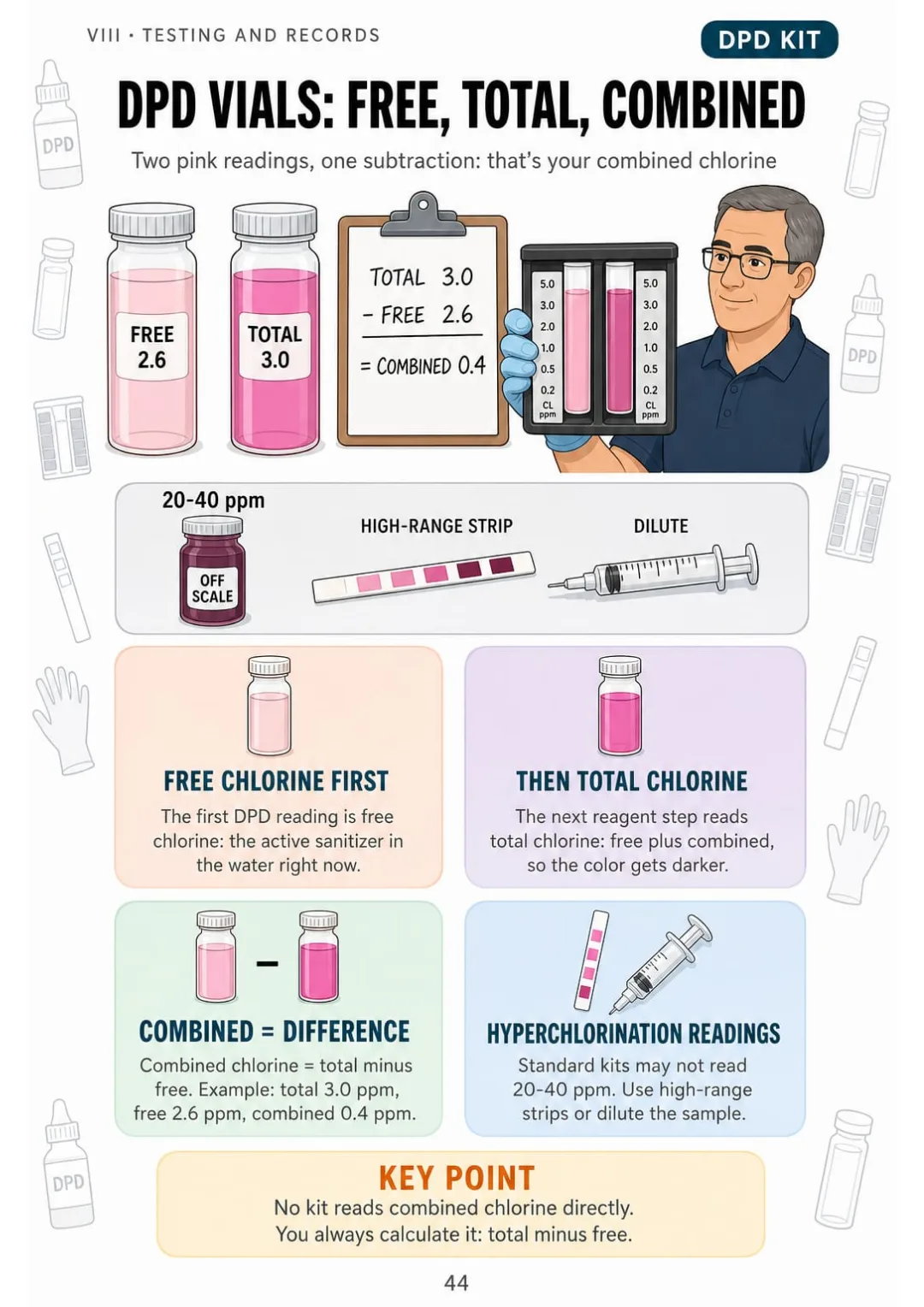
The water loop, pool math, sand, DE and cartridge filters, free and combined chlorine, the breakpoint curve, pH, the LSI, DPD testing and suction entrapment: in your notes it's a wall of text. Here each topic fits on one page, with the drawing and what you need to remember. 64 drawn pages.
🔒 Secure checkout · PDF by email · 30-day guarantee
One topic per page, the drawing that shows you how it works and the boxes with what you need to know:


Swipe to see more →
These are real pages from the book. The table of contents is the full one: 11 parts and 60 topics.
You've read the pool volume formula three times. You close the book...
...and you can't remember if 7.48 turns cubic feet into gallons or the other way around. It was just lines of text.

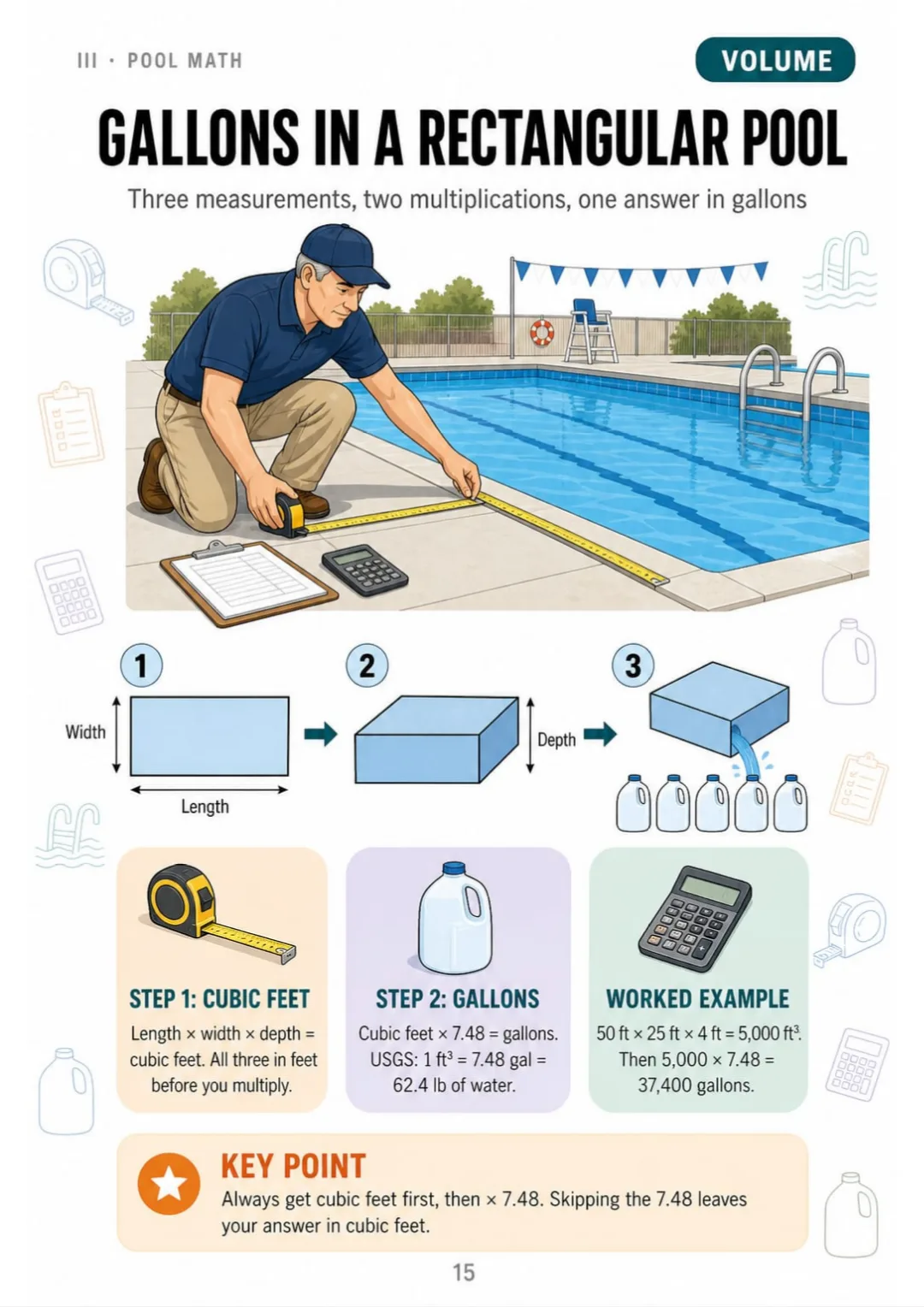
Here, gallons in a rectangular pool is one drawn page: length, width and depth on the sides of the pool, 5,000 cubic feet in the middle, then × 7.48 to get 37,400 gallons.
And on the pages next to it, every calculation gets its own: round pools and spas, the average depth of a sloped pool, turnover time, flow rate in GPM and filter area.
First you understand why it's done that way. Then the steps come back on their own.

The CPO course, rules and risks, pool math, recirculation, filtration, disinfection, water balance, testing and records, secondary treatment and spas, contamination, entrapment and chemicals, and the final review: 64 pages, all drawn
Imagine this:
Instead of rereading half a page about breakpoint chlorination without being able to picture it...
...you open the page and find the curve drawn out: the rise, the dip where the chloramines break apart, then free chlorine climbing.

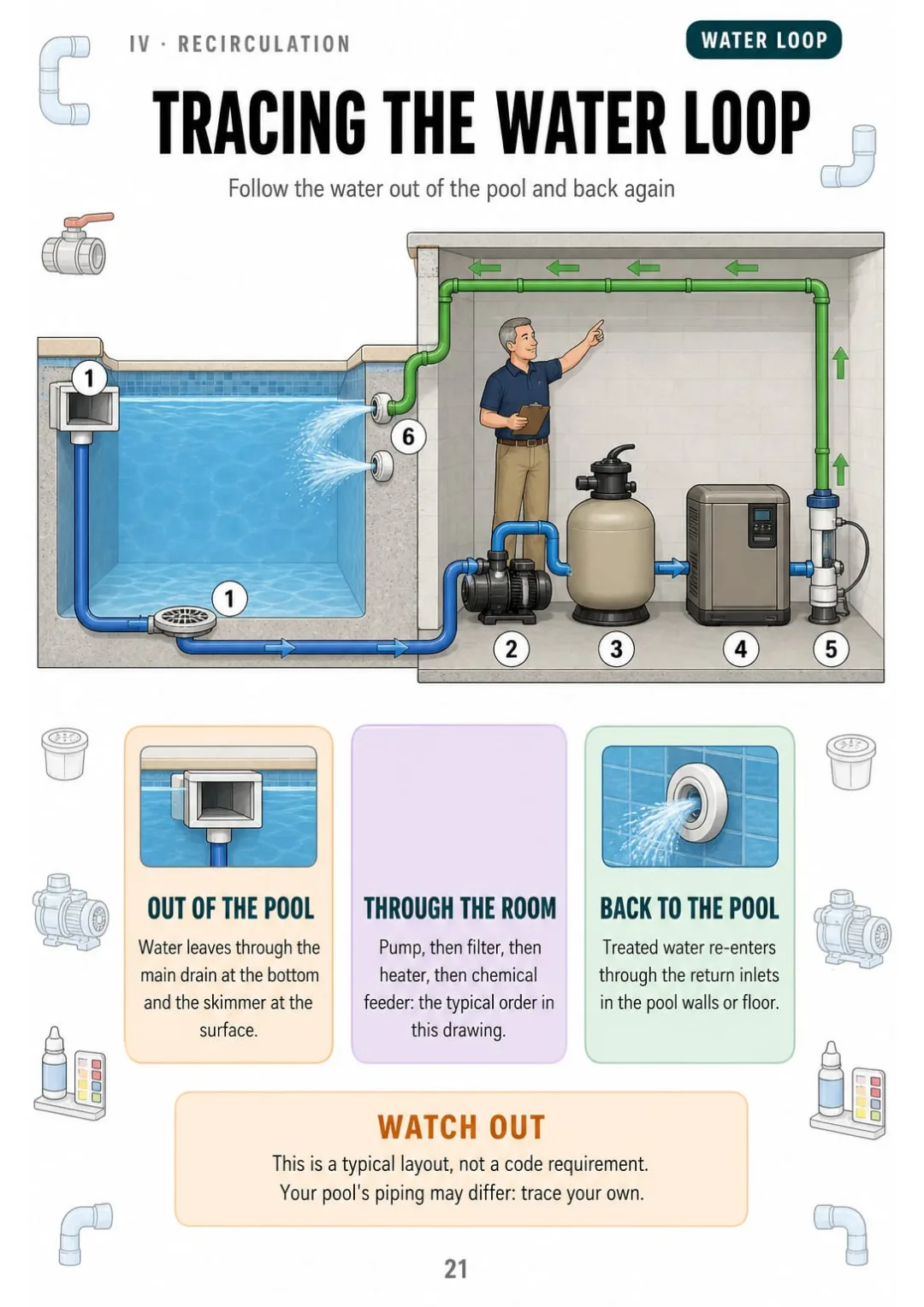
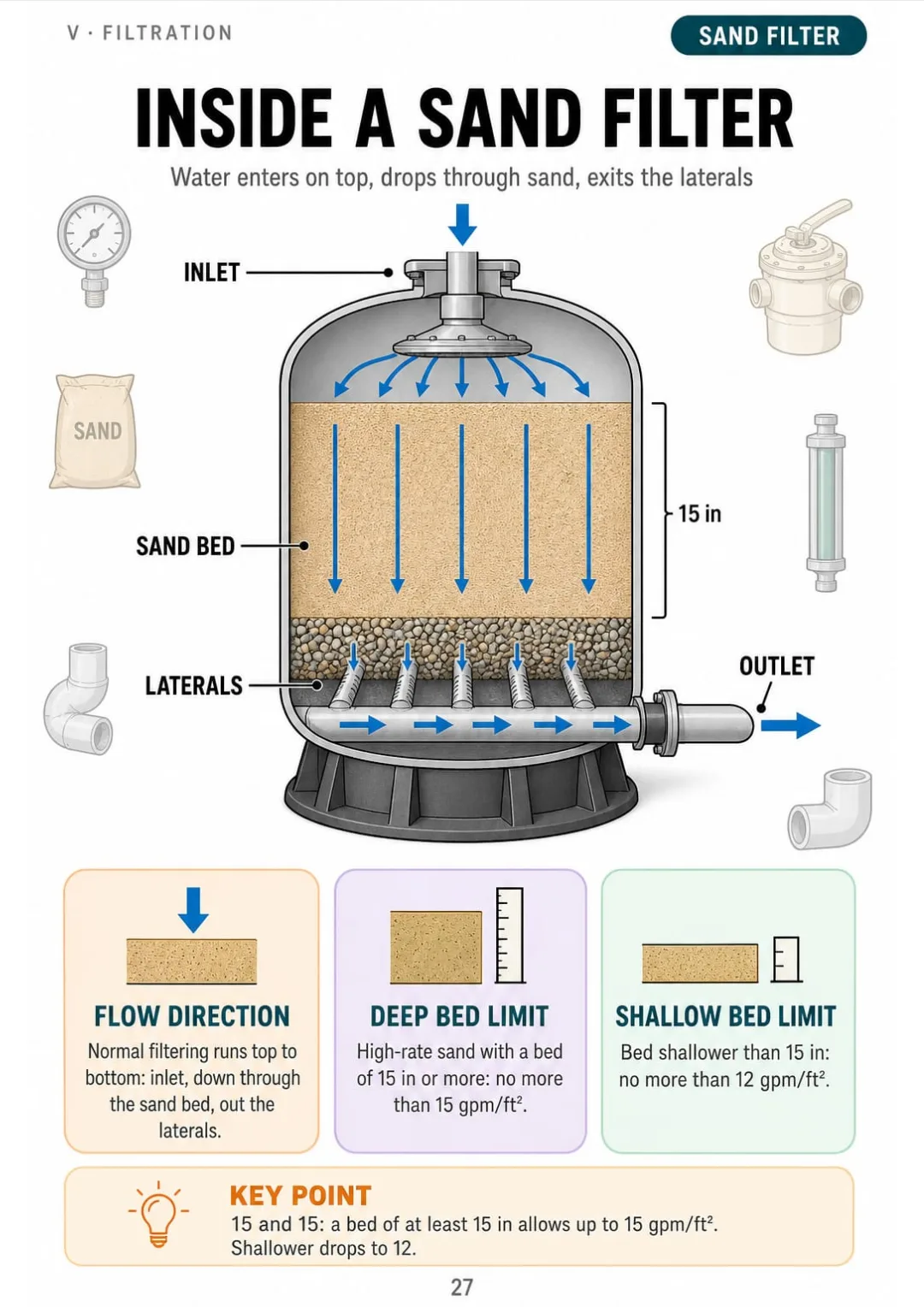
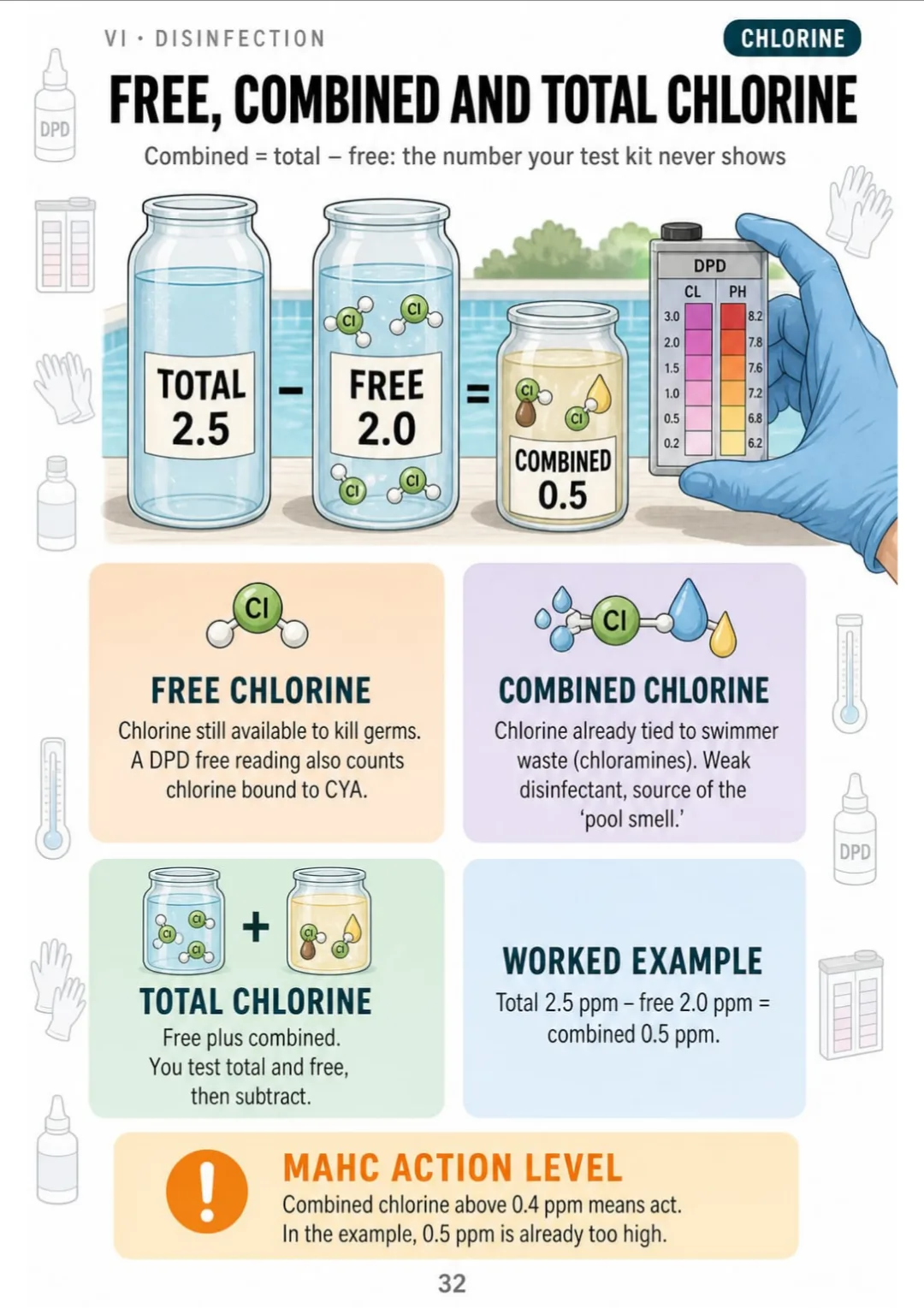
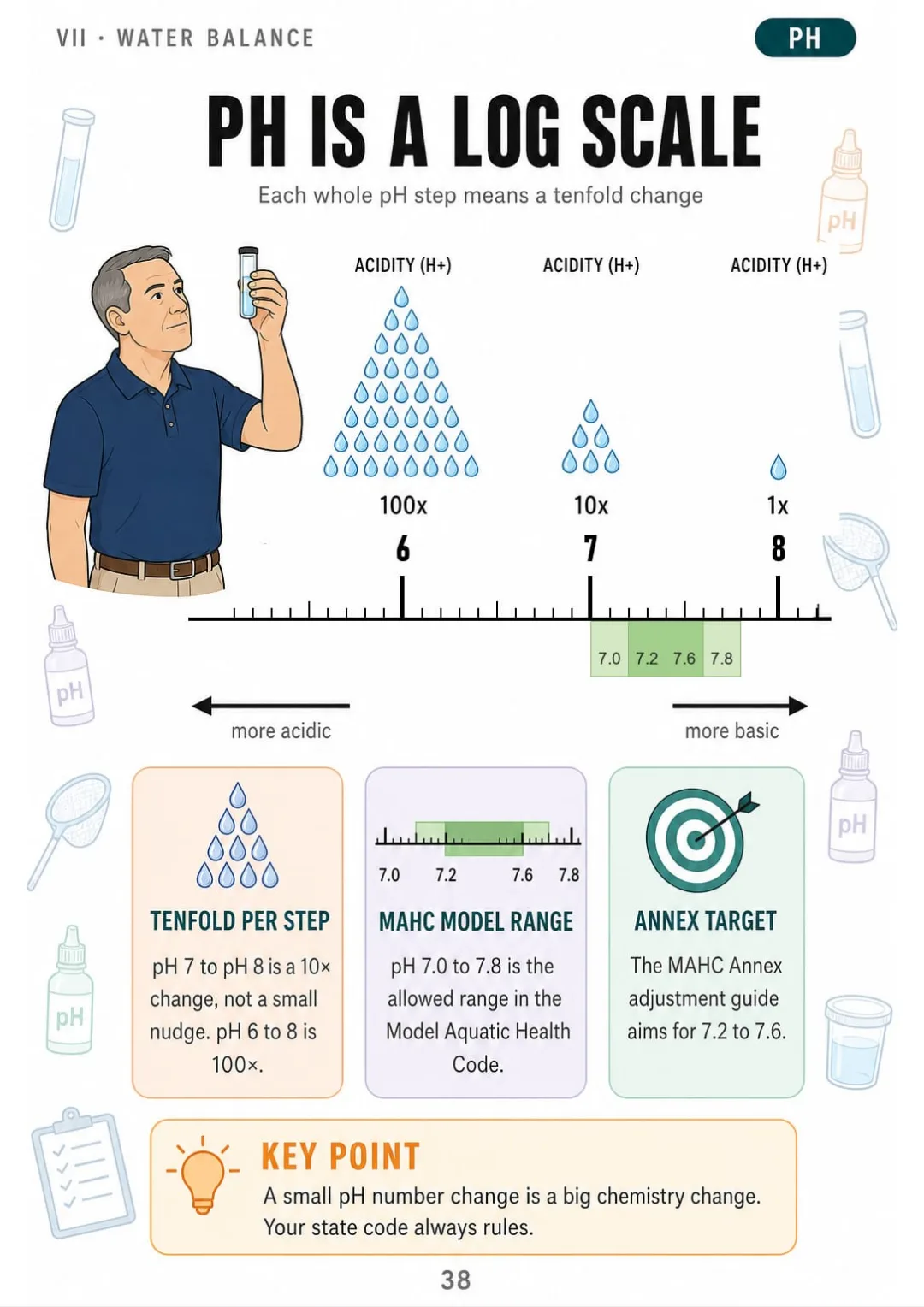
And the water loop, the three filters, free and combined chlorine, pH and the LSI turn into drawings and tables you can read at a glance.
You stop repeating and start understanding.
That's exactly what The Pool Operator Sketchbook does. It's not “another manual.” It's 64 pages with 60 drawn topics in 11 parts, one topic per page, and at the end a review part with look-alike terms, common pool math mistakes and an exam day checklist.
Because what your brain sees organized, it remembers.
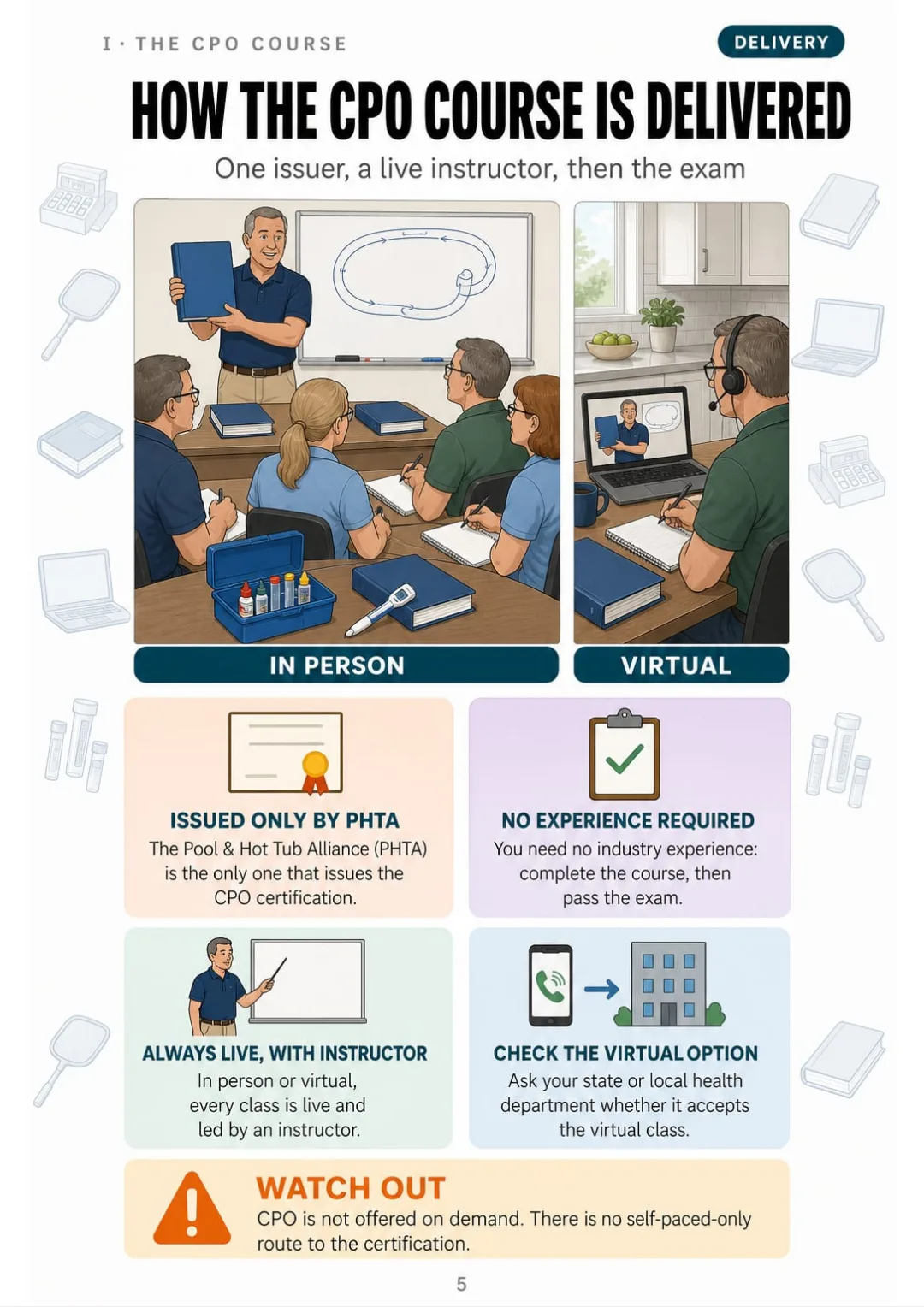
How the CPO course is delivered, the two-day class vs. the blended format, the exam at the end of class, five-year validity and how to use this sketchbook.
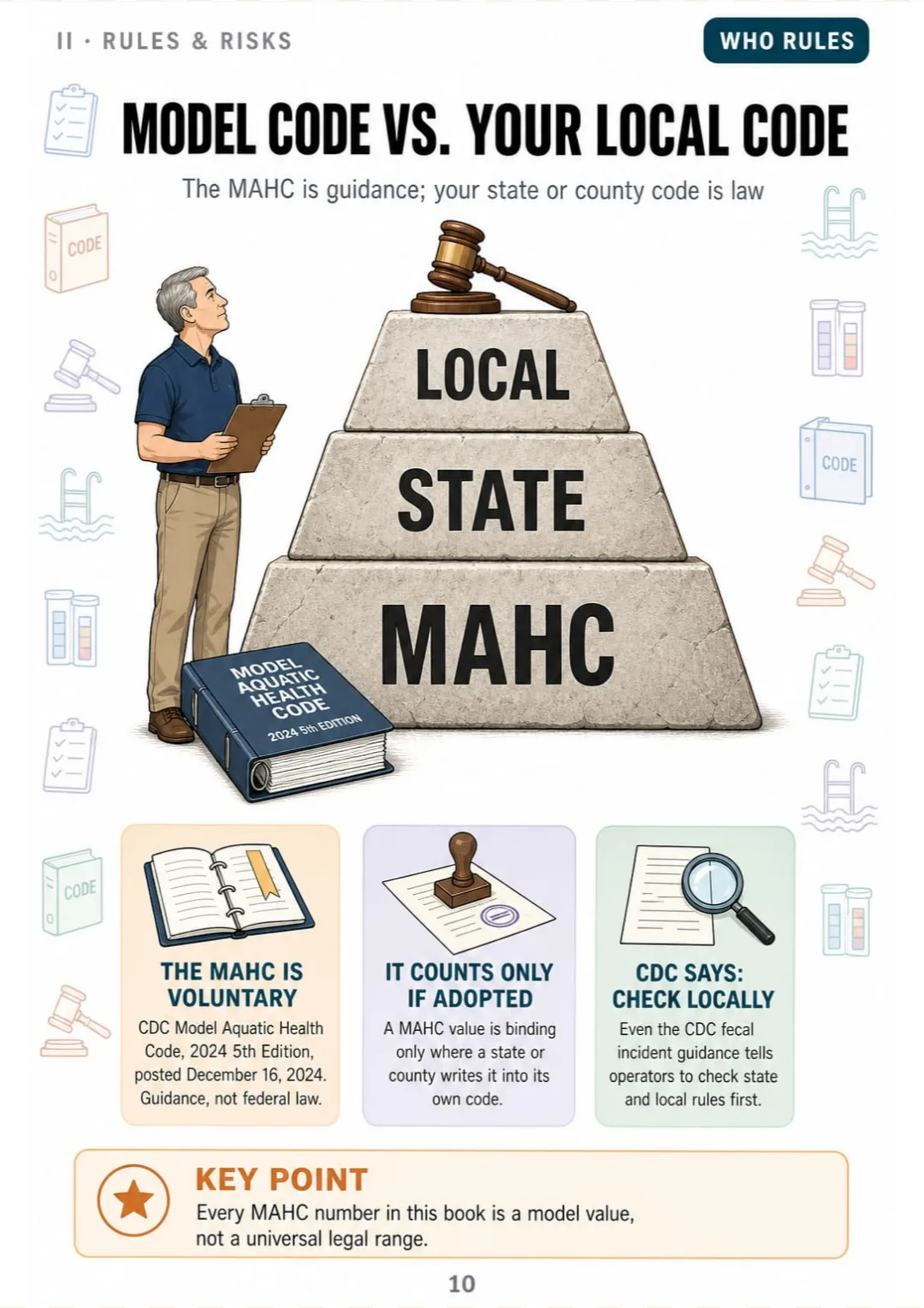
Model code vs. state and local code, two state rules side by side, when a qualified operator must be available, the hazards you prevent and how germs spread in pool water.
Gallons in rectangular, round and sloped pools, turnover time, flow rate in GPM and filter area, with every step shown, so the math on the board looks like the math on the page.
The water loop from main drain and skimmer to returns: pumps and priming, the strainer basket, gauges, heaters, feeders and the flow meter.
Sand, DE and cartridge filters in cutaway, how to backwash, precoat or clean each one, and how to read the pressure rise.
Free, combined and total chlorine, the breakpoint curve, hypochlorous acid vs. hypochlorite, chlorine products, bromine and cyanuric acid, so the numbers in your daily log finally mean something.
pH on a log scale, total alkalinity, calcium hardness, TDS, the saturation index formula and corrosive, balanced or scale-forming water.
The DPD kit and its vials, running the tests in order, where to take the sample, how often to test and what goes in the daily log.
UV and ozone in the loop, how spas differ in chemistry, temperature and turnover, and chloramines in indoor air.
Formed stool, vomit and diarrheal incident response per CDC, hyperchlorinating with stabilizer, the five entrapment hazards, drain covers and the VGB Act, and chemical storage.
Look-alike terms side by side, common pool math mistakes, chemistry numbers to recognize, backwash, precoat or clean, and an exam day checklist.
At the end of the book: A review part with look-alike terms, common pool math mistakes and an exam day checklist.
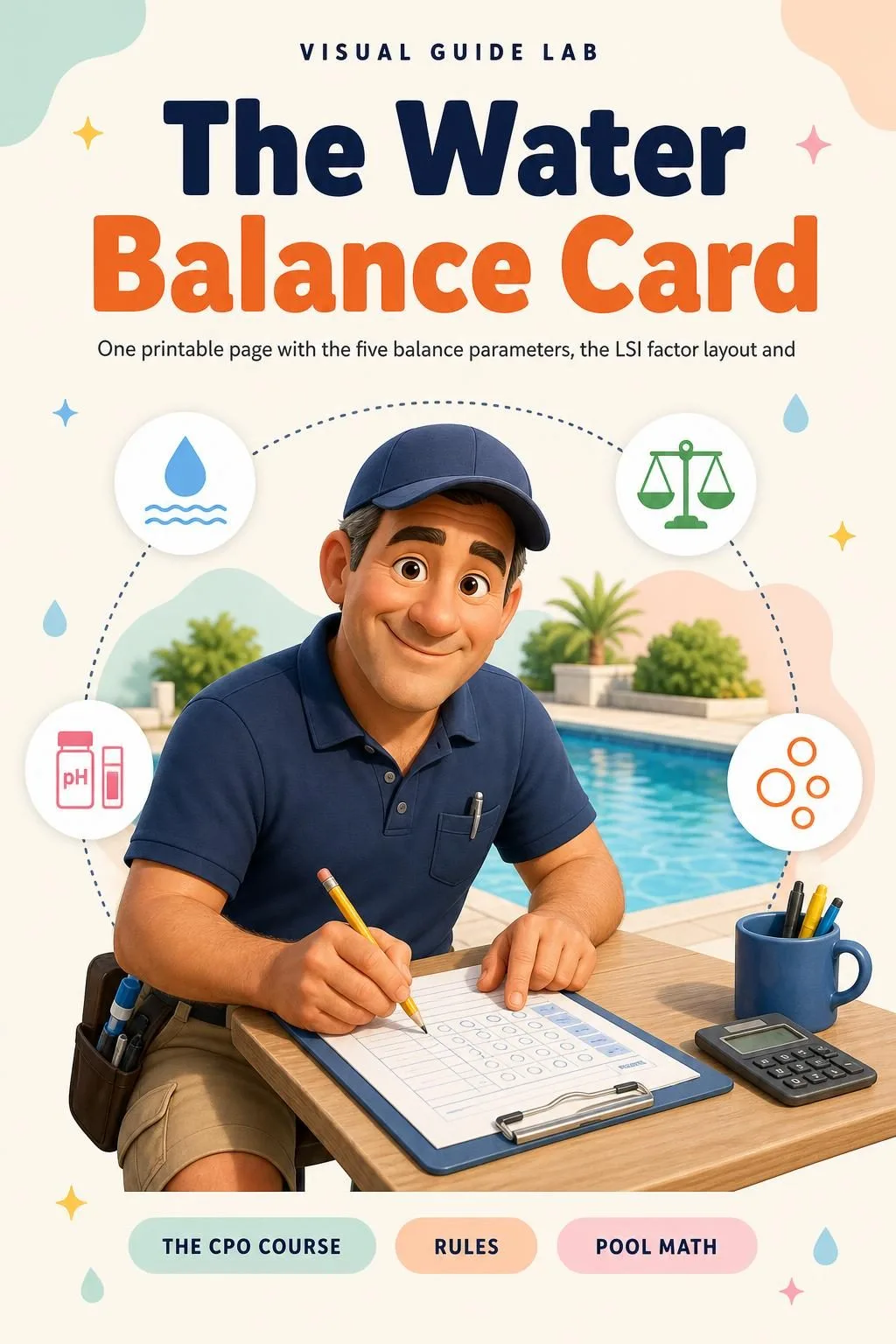
One printable page with the five balance parameters, the LSI factor layout and the corrosive / balanced / scaling bands, so you can check balance at a glance.

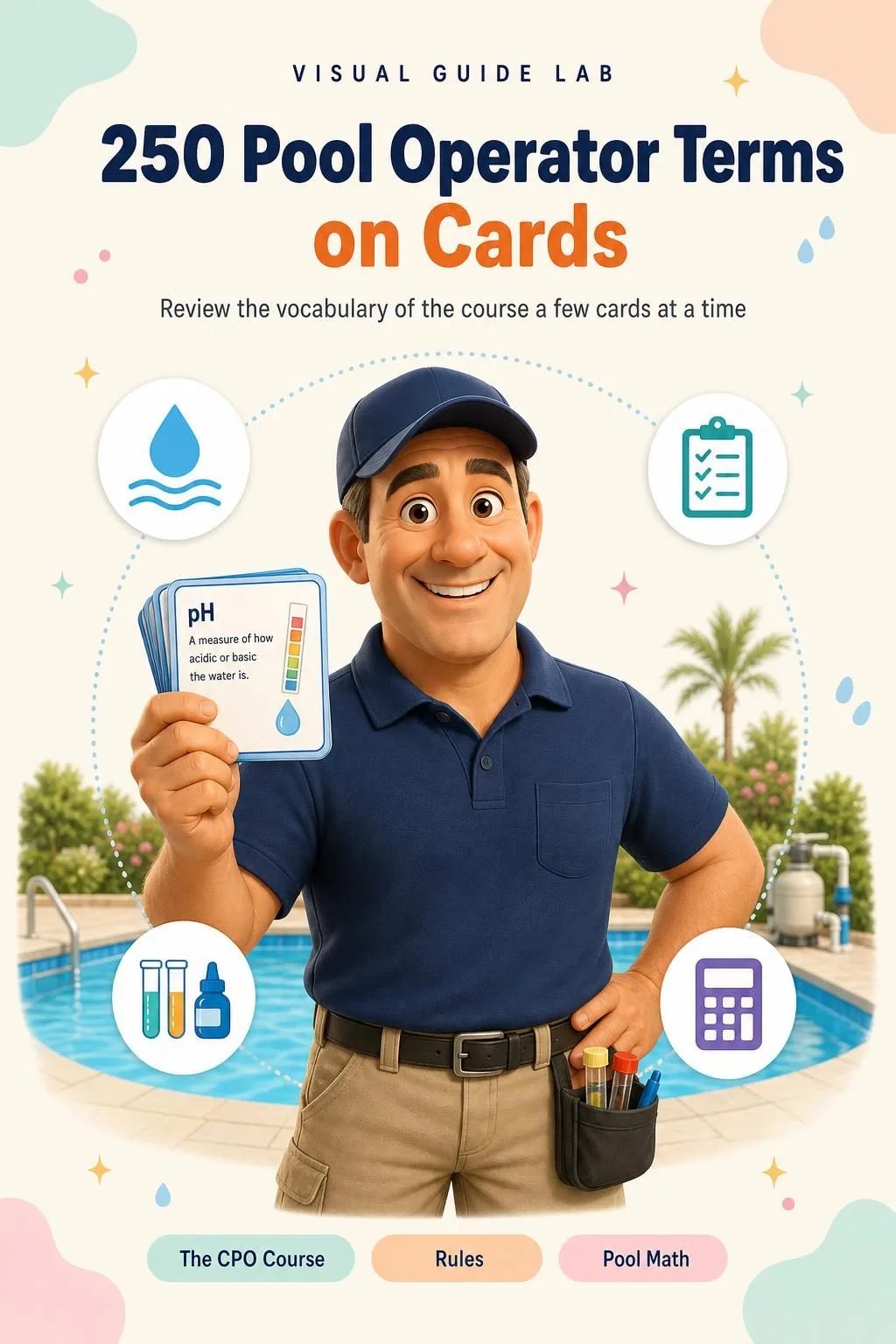
Review the vocabulary of the course a few cards at a time: the term on the front, a one-line definition and a tiny sketch on the back.
📄 This is a digital PDF book sent to your email: nothing is printed or shipped.
PDF by email: The Pool Operator Sketchbook reaches your inbox as a PDF, and the two free books come by email too. One-time payment, no installments or hidden costs.
Go through the water loop, the filters and the pool math one page at a time, so the class isn't the first time you see them.
The review part puts the look-alike terms, the common math mistakes and the chemistry numbers to recognize side by side, plus an exam day checklist.
A quick visual refresher of what you handle every day: DPD testing, the daily log, the breakpoint curve and the LSI, checked against the 2024 MAHC.
📄 This is a digital PDF book sent to your email: nothing is printed or shipped.
30-day guarantee: tell us what didn't work and we'll refund 100%.
You have 30 days to try The Pool Operator Sketchbook and both bonus books. If it doesn't work for you, email us, tell us what didn't work, and we'll refund 100% of what you paid. One-time payment, no subscription.
You get The Pool Operator Sketchbook as a high-resolution PDF by email, along with both bonus books: The Water Balance Card, a printable reference for the water balance numbers, and 250 Pool Operator Terms on Cards, printable term cards to review. It arrives at the email address you enter at checkout.
A one-time payment of US$ 37. No installments and no subscription.
For maintenance staff and pool operators at hotels, HOAs, apartment complexes, clubs, gyms and public pools who are signed up for the CPO course, and for certified operators getting ready to renew. It isn't written for beginners only: it puts in order what you already see on the deck. Check the table of contents above to see the topics.
The CDC Model Aquatic Health Code (2024 MAHC, 5th Edition, and its Annex), the CDC Fecal Incident Response Recommendations (2018), CPSC guidance on the Virginia Graeme Baker Pool and Spa Safety Act, EPA and CDC pool chemical safety guidance, and PHTA's public course information. The source is named on each page. It doesn't cover all 50 state codes: it teaches the model code that states and counties can adopt, and shows two state rules side by side so you know what to look up in yours. Your state and local health code always rules.
No. It's an independent study guide. It is not the PHTA handbook and is not affiliated with or endorsed by PHTA. CPO is a registered trademark of PHTA, used here only to describe the certification.
The handbook is the official text, and you get it with your class. This sketchbook doesn't replace it or the course: the CPO certification is issued only by PHTA, after its course and exam. What it adds is the same topics drawn, one per page, so you can picture the water loop, the filters and the chemistry before class, and review them at night after work.
No. The practice questions in the optional add-on books are original, written for those books. They are not official questions from any exam. They're there to help you train.
Yes. The PDF is made to print, so you can bring the pages to class or keep the Water Balance Card by the test kit.
30-day guarantee: tell us what didn't work and we'll refund 100%.
You don't have to reread the same page hoping it sticks this time.
You don't have to memorize formulas and readings you can't picture.
And you definitely don't have to walk into your CPO class without knowing where to start.
One last thing before you decide: the CPO class moves fast. With The Pool Operator Sketchbook you get the water loop, the pool math and the three chlorines on one page each, to open before class and keep by the test kit after.
One-time payment: US$ 37 · Guarantee: 30 days · PDF by email
YES, I WANT THE POOL OPERATOR SKETCHBOOK FOR US$ 37📄 This is a digital PDF book sent to your email: nothing is printed or shipped.